


Maximizing Government Relief for Tradies in 2026: Fuel, Registration, and Business Savings

With petrol and diesel prices continuing to put pressure on cash flow, many tradies are asking the same question:

“Is there any government help available?”
Tradies face rising costs every year, from fuel expenses to vehicle registration and everyday business operations. In 2026, several government relief programs aim to ease these financial pressures, helping tradies keep their businesses running smoothly and profitably. Understanding these relief options can make a significant difference in managing expenses and boosting savings.
This post breaks down the key government relief initiatives available for tradies in 2026, focusing on fuel subsidies, vehicle registration discounts, and small business savings. You will find practical tips on how to access these benefits and examples of how they can impact your bottom line.
Fuel Relief Programs for Tradies
Fuel costs are one of the largest expenses for tradies who rely on vehicles and machinery daily. The government recognizes this burden and has introduced targeted relief programs to reduce fuel expenses.
1. Temporary Fuel Excise Relief
The Federal Government has temporarily reduced fuel excise from 52.6 cents per litre to 20.6 cents per litre between 1 April and 30 June 2026, helping reduce fuel costs at the bowser. The reduction is expected to lower fuel prices by around 32 cents per litre (plus GST). So this type of relief is instantly available at the bowser and does not require a claim.
For a tradie filling a 100-litre tank each week, that could mean savings of around $32 per fill during the relief period.
2. Fuel Tax Credits (For Eligible Businesses)
Some businesses may be able to claim Fuel Tax Credits through their BAS.
These credits generally apply to:
Heavy vehicles over 4.5 tonnes
Machinery and equipment
Generators
Fuel used off public roads
Unfortunately, fuel used in standard utes and work vehicles travelling on public roads is generally not eligible. However, if your business operates generators, earthmoving equipment, forklifts, or heavy vehicles, it is worth checking your eligibility.
Check your eligibility here: https://www.ato.gov.au/businesses-and-organisations/income-deductions-and-concessions/incentives-and-concessions/fuel-schemes/fuel-tax-credits-business?utm_source=chatgpt.com
Tips to Maximize Fuel Savings
Keep detailed fuel logs to prove business use.
Combine fuel relief with fuel-efficient driving habits.
Check for regional or state-specific fuel relief programs.
3. Victorian 20% Rego Rebate
Vehicle registration is another significant cost for tradies, especially those with multiple vehicles or heavy machinery. The government offers registration discounts and rebates to ease this expense.
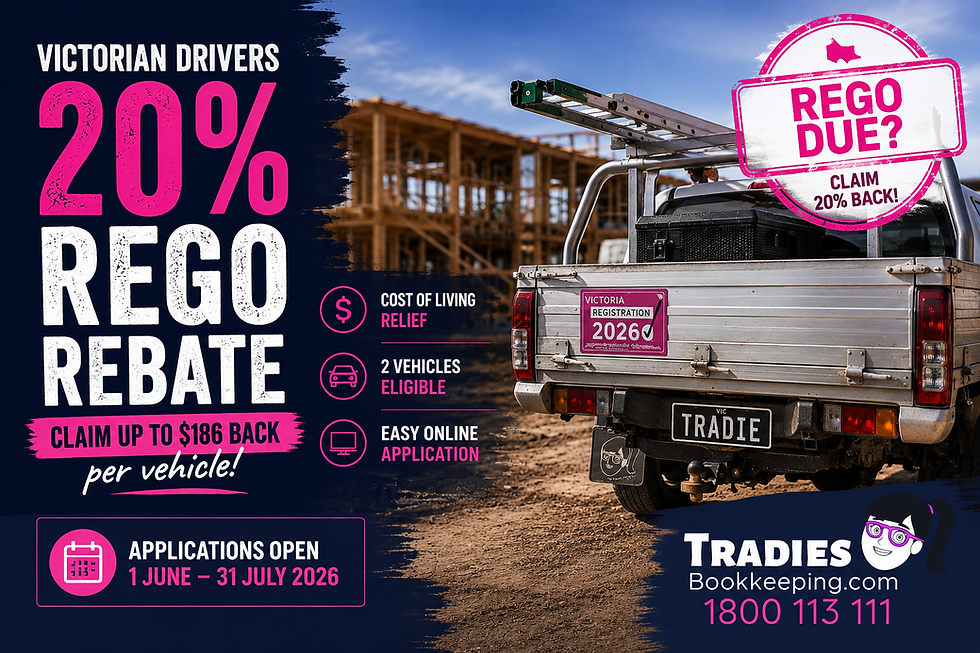
Victorian tradies may be eligible for a 20% rebate on vehicle registration costs through a state government cost-of-living initiative. Eligible vehicle owners can receive up to $186 back per vehicle and can claim on up to two light vehicles registered in their name.
This includes:
Cars
Utes
Vans
4WDs
Motorcycles
Light trucks under 4.5 tonnes
The rebate applies to registration payments made between 1 July 2025 and 30 June 2026, with applications open between 1 June and 31 July 2026.
For many tradies running one or two work utes, this could mean a few hundred dollars back simply for claiming something they have already paid.
4. The $20,000 Instant Asset Write-Off
One of the biggest wins for small business owners is that the $20,000 Instant Asset Write-Off is set to become permanent. A tradie investing $10,000 in new tools could write off the entire amount in the 2026 tax year, reducing taxable income and saving thousands in tax payments.

Businesses with turnover under $10 million can immediately deduct eligible assets costing less than $20,000 rather than depreciating them over several years.
This can help when purchasing:
Tools
Equipment
Generators
Trailers
Computers
Workshop equipment
Smaller business vehicles and assets that fall within the threshold
Check with your accountant if that has been applied when doing your tax return.
How to Benefit
Keep accurate records of all business expenses.
Consult with an accountant to identify all eligible deductions.
Monitor government announcements for new grants or relief packages.
Steps to Access Government Relief

Identify eligibility: Review your business structure and vehicle use.
Register with relevant agencies: Use government websites to apply for fuel subsidies and registration discounts.
Maintain documentation: Keep receipts, logs, and proof of business use.
Consult professionals: Accountants or business advisors can help maximize benefits.
Stay informed: Relief programs can change; subscribe to government updates.
Don't Forget the Basics
Even if you don't qualify for every rebate available, fuel, vehicle expenses, equipment running costs, and business travel remain legitimate tax deductions when properly documented, can make a significant difference at tax time.
Keeping accurate records of:
Fuel purchases
Vehicle logbooks
Registration costs
Repairs and maintenance
Business travel
Equipment operating expenses
With rising operating costs affecting nearly every trade, making sure you're claiming everything you're entitled to has never been more important.
At Tradies Bookkeeping .Com, we help tradies stay on top of their bookkeeping, BAS obligations, deductions, and business compliance so no money gets left on the table.
Need help understanding what your business can claim? Get in touch and let’s make sure you’re keeping more of what you earn.

References & Further Information
For official information relating to fuel relief, Fuel Tax Credits, the Victorian 20% Rego Rebate and the $20,000 Instant Asset Write-Off, please refer to the following government resources:
Information provided on this page is general in nature and may not apply to every business situation. Always speak with your accountant or bookkeeper regarding your individual circumstances and eligibility.


Comments